

Try it for free
Generate your professional voice message with AI voice in just a few seconds
Create your account for free
You will be able to download this message and discover all the features in your Voconix space
Create my Voconix account
You have exceeded the 20-word limit for this test. Create a Voconix account to send messages of up to 100 words each.
Discover all our offersText-to-speech : the comprehensive guide to professional voicemails
You're looking for a text-to-speech tool. Perhaps for your business telephone messages. Perhaps to understand how to choose the right solution from all those available on the market. Maybe because you've heard of AI voices and want to assess whether they can really be used in a professional context.
This guide answers all these questions: what TTS really is, how it works, in what contexts it is used, and why consumer-grade tools do not meet the same needs as those designed for business telephony. If you need a solution straight away, you can create your first professional voice message for free on Voconix in under 30 seconds.
Definition and history: from the laboratory to the invisible
The definition
Text-to-speech (TTS), or speech synthesis, is the technology that converts written text into audible speech. Given a text input, it produces an audio file that can be played on any device, integrated into an app, or uploaded to a telephone system. It is the opposite of speech recognition (speech-to-text).
Sixty years of evolution in four major stages
Text-to-speech did not originate with AI. Its history illustrates how a technology evolves from a laboratory curiosity into an invisible part of everyday life.
1950–1970: Physical synthesisers
Machines that attempted to replicate the physical mechanisms of the human voice. The result was immediately recognisable as artificial.
1980–2000: Synthesis by concatenation
A human records thousands of syllables, which are then pieced together to form any given sentence. The quality is improving, but the joins are sometimes noticeable.
2000–2015: Statistical modelling
Statistical models (HMMs) produce a more natural-sounding synthesis for short sentences, but remain recognisable in long texts.
Since 2016: The neural revolution
Google DeepMind’s WaveNet marks a clear turning point: synthetic voices now regularly fool human listeners in blind tests.
It is this level of quality that professional TTS tools now offer, such as Voconix : neural voices that sound natural, without the mechanical quality of previous generations.
How does TTS work? modern ?
Understanding how TTS works explains why some tools are better than others, and why some contexts of use are more demanding than others.
Step 1: analysing the text
Before producing any sound at all, the system must understand the text: homographs («fils» – children or fishing line?), figures and numbers («1,500€» is read as «one thousand five hundred euros»), acronyms («SNCF» letter by letter, «NASA» as a single word), punctuation and prosody. Voconix also incorporates a system for memorising difficult pronunciations : Once you have corrected the pronunciation of a proper noun, it is retained permanently.
Steps 2 and 3: phonemes, then speech synthesis
The text being analysed is converted into a sequence of phonemes (around 36 in French), enriched with prosodic information. A neural network model, trained on hundreds of thousands of hours of recordings, then generates the acoustic features, which are converted into a sound wave by a vocoder. The whole process takes just a few tens of milliseconds.
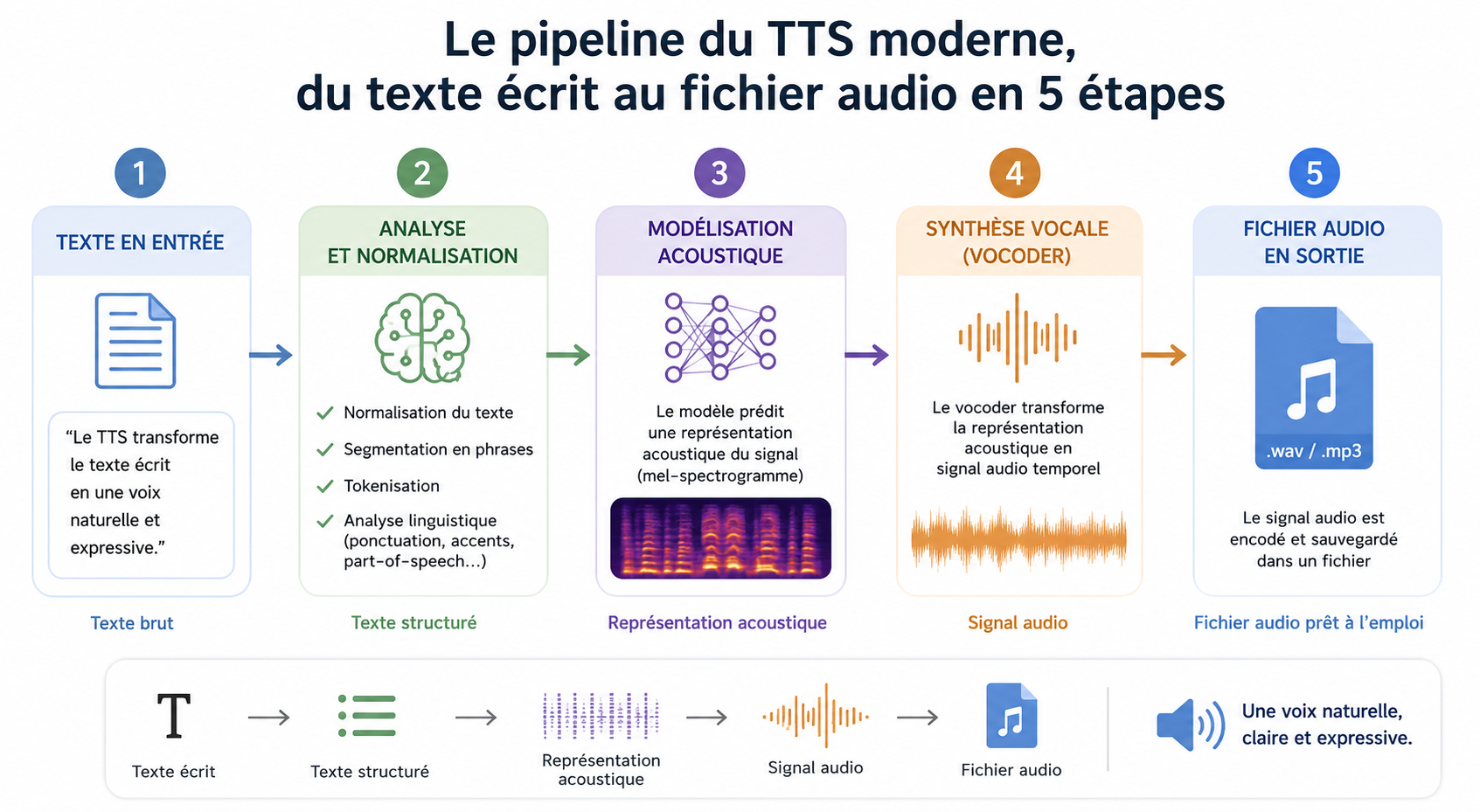
The main use cases for the text-to-speech
TTS is used in a wide variety of contexts, each with its own specific constraints.
Accessibility
Visually impaired people, those with dyslexia, and those with reading difficulties: TTS is a real driver of inclusion.
Content creation
Video narration, podcasts and rapid multilingual localisation for content creators.
E-learning
Voice-over for training modules, with consistency guaranteed across dozens of modules.
Voice assistants
Siri, Alexa: conversational AI agents with very low latency.
Embedded Systems and IoT
GPS, station announcements, interactive kiosks, offline functionality.
Business telephony
The most common use in business. Find out more about this use case.
TTS in business telephony: why it’s a world of its own
This is the most common practice in business, and, paradoxically, one of the least well-documented. Whenever a caller hears a welcome message, a IVR menu or a professional answering machine, there’s a good chance it’s a synthetic voice.
The audio format: the first invisible constraint
Telephone systems (IPBX, PABX, cloud-based solutions) do not accept just any audio file: the sampling rate, encoding and whether the file is mono or stereo vary depending on the system. An incorrectly formatted file is either rejected or played back with distorted sound.
Accurate pronunciation
The company name, contact numbers, opening hours: first impressions depend on these details being accurate.
Voice + music
A message is never just a bare voice. The mixing process follows precise rules and the the music must be royalty-free.
Fleet consistency
An average of around ten messages per company, which must be consistent with one another.
Delivery to the installer
The final kilometre, which is often overlooked. An automatic notification avoids delays.
AI voices vs human voices: which one to choose ?
The answer depends on the message. Here’s what each option does best.
What the AI voice does better
Speed (30 seconds for an edited message), consistency over time, volume (40 voicemail or 150 establishments at the click of a button), native multilingual speaker, and at a cost that is still a fraction of that of a studio recording.
What the human voice does best
The complex emotional tone required for an important corporate message, the absolute uniqueness of a genuine sound signature, and the creative interpretation an actor brings to a brief.
| Criterion | 🤖 AI voice | 🎙️ Human voice |
|---|---|---|
| Rapid creation | ✅ | ⏳ |
| Consistency over time | ✅ | ⚠️ |
| Cost | ✅ | ⚠️ |
| Volume of messages | ✅ | ❌ |
| Multilingual | ✅ | ⚠️ |
| Emotional register | ⚠️ | ✅ |
| Uniqueness / signature sound | ⚠️ | ✅ |
Voconix offers both: 25 AI and human voices in 5 languages.
How to choose a TTS tool for business telephony ?
The output format
Is it compatible with your IPBX? Voconix automatically generates formats suitable for each system.
High-quality French voice-overs
Try it out with your own text, particularly proper nouns and numbers.
Embedded and legal music
Check the SACEM/SCPA rights : Voconix includes over 10,000 royalty-free tracks.
Managing a fleet of messages
Historical data, organisation by employee or by site, consistency over time.
Automated delivery
Without automatic notification, every update requires manual transmission.
TTS and the questions ethical to find out
Voice cloning: powerful and regulated
The best TTS technologies can create a voice clone from just a few minutes’ recording. If used without consent, this constitutes a serious violation of human rights. For a company creating a brand voice based on a real voice, an explicit agreement covering commercial use is essential.
Audio deepfakes and their impact on voice-related professions
Current technology makes it possible to create highly realistic recordings of statements that were never actually made, posing a real threat to confidence in voice authentication. The market for professional voice actors is also adapting to this shift, with debates arising over voice image rights.
The future of TTS: where is it heading? technology ?
Today
Virtually zero latency
Under 50 ms, for voice agents that are indistinguishable from humans.
2026
Emotions that can be controlled
Complete direction of the actor without recording a single second of sound.
2027
Brand voice
An asset to be developed and protected, just like a logo, across all touchpoints.
2028
Voice-based AI agents
TTS integrated into continuous, natural conversational flows.
2030
Transparent multilingualism
Switching between languages within the same message, whilst maintaining the same tone of voice.
Conclusion
In sixty years, text-to-speech has come a long way, from the first electronic synthesizers to today's neural voices that deceive the human ear. For companies, the question is no longer «Is TTS good enough? The answer is yes in the vast majority of professional cases.
The real question is «What tool, for what purpose, with what guarantees?» For business telephony, this means a solution that takes into account the technical constraints of IP-PBX systems, integrates voice and music, ensures consistency across your messages, and automates delivery to your installer.
Voconix
Voconix is this solution
Create your professional voice messages in 30 seconds, with 25 voices, over 10,000 royalty-free music tracks, in 5 languages, with automatic delivery to your installer.
Try it for freeSee offers and ratesHow to create your text-to-speech voice message with Voconix
Text-to-speech is a technology, but using it shouldn’t be.
Write your text
Pre-written templates are available for every situation: welcome messages, voicemail, IVR, on-hold messages, closing messages and holiday announcements.
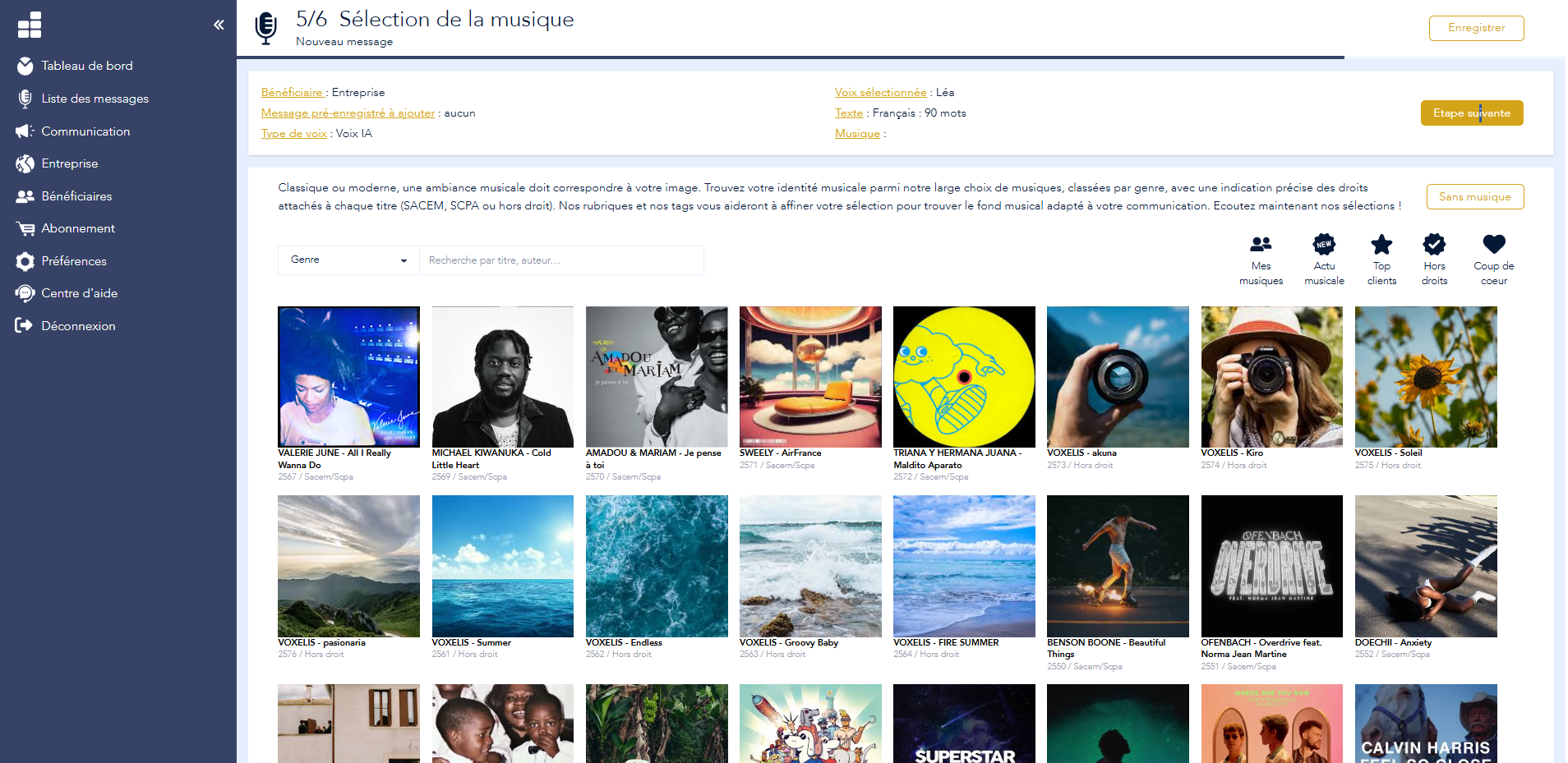
Choose voice and music
25 AI and human voices in 5 languages. Music from a selection of over 10,000 royalty-free tracks. Automatic mixing included.
Download or deliver
A file compatible with your IPBX, or an automatic notification from your telecoms installer.
Voconix
Try it now for free
Type in your text, choose a voice, and listen to the result. No credit card required.
Create your first message for freeSee pricesExamples of text-to-speech messages ready-to-use
These templates can be used directly in Voconix.
«Hello, you’ve reached [Company name]. Our advisers are available Monday to Friday from 9am to 6pm. If you have any enquiries, please email us at contact@[domain].fr. We look forward to hearing from you.»
Create this message →«Hello, this is [First name Surname]»s voicemail. I’m currently unavailable. Please leave your name, your number and the reason for your call, and I’ll call you back as soon as possible.”
Create this message →«Thank you for calling. All our advisers are currently available. Your call is important to us. We’ll be with you in a moment.»
Create this message →«Welcome to [Company]. For the sales department, press 1. For the technical department, press 2. For the accounts department, press 3. To speak to an advisor, press 0.»
Create this message →«Hello, due to an unscheduled closure today, our offices are closed. We will be back on [date] at [time]. You can email us at contact@[domain].fr.»
Create this message →«Hello and thank you for calling [Company]. Your call will be answered in a few moments. An advisor will be with you shortly.»
Create this message →«Hello, the [Company] team will be on holiday from [date] to [date]. We’ll be back on [date] and will get back to you as soon as we return.»
Create this message →«Hello, you’ve reached [Company]. For French, press 1 / For English, press 2.»
Create this message →Other uses of text-to-speech Voconix
Pre-hook
With Voconix text-to-speech, create your professional pre-hook in just a few seconds. A natural AI voice that immediately reassures your callers and reinforces your company's image even before the first word is spoken.
Urgent message update
Change of colleague, moving house, new working hours: an out-of-date voicemail message damages your image. With Voconix text-to-speech, you can update all your messages in less than 30 seconds, without a studio and without waiting.
Manage your sales operations
Ensure that each member of staff has a text-to-speech voice message that is consistent with your corporate identity. Voconix lets you generate all your team's voices from a single space, with the same voice and the same tone on all lines.
Business Answering Machine
Even when closed, you can inform and reassure your callers: resumption times, alternative contact point, seasonal message. With Voconix text-to-speech, you can create a voice message tailored to each situation in just a few seconds, and put it online instantly.
New employee voicemail setup
Immediately create a text-to-speech voice message for a new employee, using the same voice and tone as the rest of the team. Guaranteed consistency across all company lines, from day one.
What messages did we get last year?
Has an employee left the company? Find and modify their text-to-speech voice message in just a few seconds in the Voconix history, without having to start from scratch.
IVR prompts and auto attendant
Keep all your text-to-speech voice messages up to date with Voconix. Standard, individual, out-of-hours: each announcement is regenerated in a few seconds with the same voice, without re-recording.
Voice box
Clearly indicate who to contact in the event of absence. Voconix enables you to generate a replacement text-to-speech voice message in a matter of seconds, with the contact details of the available colleague.
100% stand-alone voicemail system
Write your text, choose your voice and immediately generate your text-to-speech voice message with Voconix. Share your creation with your team for validation before downloading.
FAQ: Text-to-Speech
What is text-to-speech (TTS)?
Text-to-speech is a technology that converts written text into audible speech. From a typed text, it generates an audio file (MP3, WAV) that can be read on any device. It is the technology that powers telephone greetings, GPS systems, voice assistants and everyday systems. Voconix uses the latest generation of neural speech synthesis to deliver professional, studio-quality voice messages.
How does AI text-to-speech work?
A TTS system first analyses the text to resolve ambiguities (homographs, numbers, acronyms, punctuation), then converts it into a sequence of phonemes. A neural model trained on hundreds of thousands of hours of human speech then generates the acoustic characteristics, which are converted into an audio file by a vocoder. The whole process takes place in just a few milliseconds.
Can I create a professional voice message using TTS?
Yes, this is one of the most widespread uses in business. Voconix has designed its tool specifically to meet telephony constraints: audio formats compatible with IPBX and PABX, automatic mixing with music, management of a fleet of messages and automatic delivery to the telecoms installer.
How long does it take to create a voice message with Voconix?
In less than 30 seconds for a simple message. You write your text, choose a voice from the 25 options available (AI or human), select optional music, and the audio file is generated immediately. No technical skills required.
How do I leave my voice message on my telephone or switchboard?
Voconix automatically generates MP3 and Telephone WAV (G.711 and G.729 codecs). You can download the file and upload it directly, or enter your telephone installer's contact details in Voconix for a direct download. automatic delivery. No further conversion is required.
Can I test Voconix for free before buying?
Yes. Voconix offers a free trial where you can create, listen to and download a complete voice message. No commitment or credit card required.
Can I retrieve and edit my voicemails after they have been created?
Voconix keeps a complete history of all your voice messages. You can retrieve, edit and re-download any message in just a few clicks, without having to start from scratch. Particularly useful for seasonal updates or organisational changes.
What audio formats are available for my voice messages?
Voice messages generated by Voconix are available in MP3 (universal format) and Telephone WAV (compressed with G.711 and G.729 codecs, optimised for IPBXs and PABXs). Each file is standardised for optimum sound quality.
Can I add music or a jingle to my voice message?
Yes. Voconix incorporates a library of royalty-free music and a selection of commercial music. You choose the title, adjust the volume to match the voice, and Voconix mixes it automatically.
Is royalty-free music really free of SACEM fees?
Royalty-free music available in Voconix can be used without SACEM or SCPA royalties. They are included in your offer and can be legally integrated into your professional voice messages.
What's the difference between AI voice and human voice for my voicemail?
The AI voice offers speed, consistency over time and total flexibility: a modified message can be generated in 30 seconds. The human voice provides a warmer, more natural sound, recommended for messages with a high symbolic value. Both options are available in Voconix and can be combined within the same company.
Can I set up a bilingual voicemail service?
Yes. Voconix offers 5 major European languages French, English, Spanish, German and Italian. You can create a bilingual message by writing your text in both languages in a single message.
What should I do if the TTS mispronounces a proper name or a specific term?
Voconix incorporates a memorising difficult pronunciations. You correct the pronunciation of a company name or atypical term once, and this correction is saved for all your future messages.
Why not simply register yourself?
Recording yourself can lead to practical problems: background noise, inadequate diction, inconsistencies between messages from different contributors, difficulty in updating easily. With Voconix, Each voice message is rendered in a studio, consistent across all the company's lines, and can be modified at any time without having to be re-recorded.
What is voice cloning and should companies be concerned about it?
Voice cloning is the creation of a synthetic voice that imitates a real human voice. Used legitimately (brand voice, preserving the voice of a sick person), it is a useful advance. Used without consent, it is a serious violation of human rights. To create a branded voice based on a real human voice, explicit consent from the person concerned is required, covering commercial use and the duration of use.
Can text-to-speech replace a professional actor?
For functional purposes (informative messages, IVR menus, voicemail), yes, in the vast majority of cases. When it comes to messages with high artistic or emotional value, an actor still has the edge when it comes to nuance and interpretation. Voconix offers both options: 25 AI and human voices, to be combined according to your needs and budget.
What is the difference between text-to-speech and speech-to-text?
These are two opposing technologies. Text-to-speech (TTS) converts written text into audible speech: you enter a text and you get an audio file. Speech-to-text (STT) does the opposite: it transcribes recorded speech into written text. Voconix is a TTS tool: it transforms your texts into professional voice messages ready for delivery to your switchboard.
Are modern TTS voices really indistinguishable from a human voice?
In the vast majority of professional applications, yes. The latest-generation neural voices faithfully reproduce the intonation, rhythm and nuances of French. For telephone messages, the quality is perfectly professional. Voconix uses latest-generation neural models with 25 available voices.
Can the speed, tone and volume of a TTS voice be adjusted?
Yes, modern TTS tools allow you to adjust the speech rate, general tone and sound level of the final file. Voconix automatically normalises the sound level of each message for a consistent, professional sound.
What is the latency of a TTS voice: how long does it take to generate an audio file?
For a telephone message of 20 to 30 seconds, modern TTS systems produce the result in just a few seconds. For Voconix, the generation – including voice and music mixing – takes place within a few seconds of the text being approved.
Can TTS express emotions in the voice?
The latest generation of neural models incorporate increasing emotional expressiveness: warmth, enthusiasm, seriousness, calm. For telephone messages, this expressiveness translates into a voice that doesn't sound mechanical: natural intonation, emphasis in the right places, respected pauses.
How do you choose the right TTS voice for your business sector?
A soft, feminine voice is ideal for the health and wellbeing sectors; a calm, masculine voice for the legal or financial sectors; a more dynamic voice for the tech and retail sectors. Voconix offers 25 AI and human voices that can be listened to directly in the tool, with no commitment.
Can TTS be used for advertising or commercial video content?
Yes, provided that the conditions of use authorise commercial use. Voconix is designed for professional and commercial use: all the audio files generated can be freely used in your business.
Is it possible to integrate text-to-speech into your own tools via an API?
Yes. Voconix offers a API enabling telecoms professionals and integrators to incorporate voice message generation into their own platforms. A dedicated programme is available for telecoms professionals.
Are the texts I enter stored or used to train AI models?
For Voconix, The data entered is processed solely to generate the audio file. Consult our general terms and conditions for full details.
Is text-to-speech compliant with the RGPD?
Voconix is a French solution, hosted in Europe. For any specific questions about RGPD compliance, our team is available at contact form.
